Absent Evidence: What Newspaper Photo Archives Never Showed — and Why It Matters
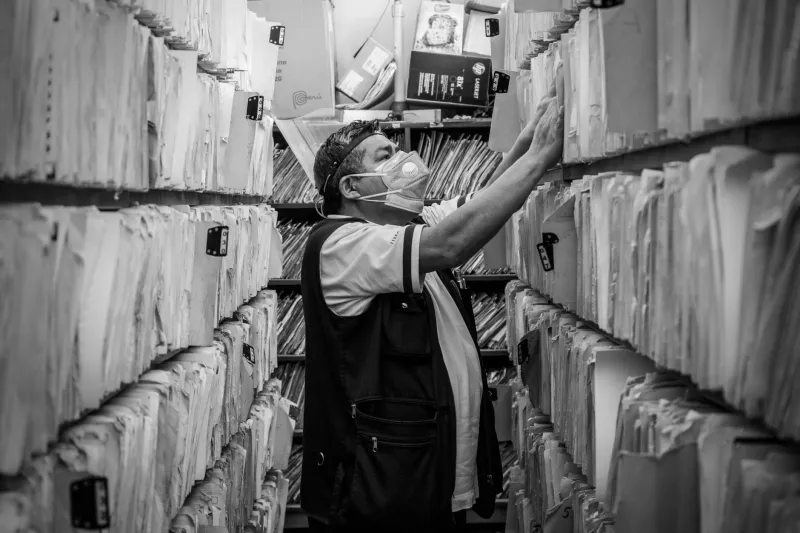
When historians open a newspaper morgue — the physical filing systems where press photographs were catalogued, stored, and retrieved — they expect to find gaps. Paper deteriorates. Floods destroy basements. Budget cuts eliminate preservation staff. But increasingly, researchers working through mid-twentieth-century press archives are identifying a different kind of absence: one that is too consistent, too selective, and too patterned to be accidental.
The photographs that are missing are not random. They cluster around specific subjects — civil rights demonstrations, the aftermath of racial violence, images of Black civic and professional life that contradicted dominant editorial narratives of the era. What looks, at first glance, like archival decay is, on closer inspection, a record of choices: choices made by editors, photo desk supervisors, and wire service managers who decided, day after day, which images were worth preserving and which were not.
Those decisions have consequences that extend well beyond journalism. Because newspaper photograph collections have long served as primary source material for documentary filmmakers, textbook publishers, museum curators, and academic historians, the images that were culled from the archive are also images that were culled from the broader historical record. Understanding how and why they disappeared is, in many respects, understanding how a version of American history was constructed by omission.
The Morgue as a Site of Historical Production
The term "morgue" for a newspaper's photograph and clipping archive is more apt than it might seem. These collections were where stories went after publication — preserved or discarded according to criteria that reflected the editorial culture of each institution. At major metropolitan dailies and wire services such as the Associated Press and United Press International, photo morgues grew into vast repositories over decades, sometimes housing millions of prints and negatives.
But preservation was never neutral. Archivists who have studied morgue organization at papers across the South and Midwest have documented filing systems that segregated photographs by race — literally maintaining separate folders for "Negro" subjects — and that applied dramatically different retention standards to those folders. Photographs of Black subjects deemed unflattering to white readerships were frequently discarded outright. Images documenting police brutality or white mob violence were, in some documented cases, surrendered to law enforcement or destroyed at the request of local officials.
At wire services, the problem operated at a different scale. Because wire photographs were distributed nationally and internationally, decisions made at the editorial level in New York or Chicago about which images to transmit shaped what regional papers even had the opportunity to publish — and, subsequently, what they had the opportunity to archive.
Case Studies in Deliberate Erasure
The contours of this systematic absence become concrete through specific collections. One of the most extensively documented cases involves the photograph archive of a major Southern daily, whose morgue was donated to a state university library in the 1980s following the paper's closure. When archivists began cataloguing the collection, they discovered that folders corresponding to periods of intense civil rights activity — the early 1960s in particular — were conspicuously thin, while contemporaneous administrative records referenced far larger volumes of photographs being processed during those same weeks.
Cross-referencing with the paper's published editions revealed that photographs had been taken and, in some instances, transmitted by wire — yet the prints and negatives were simply absent from the archive. In several cases, handwritten notations on folder tabs indicated that materials had been "removed" or "returned," without further explanation.
A separate and well-documented case involves the photograph collection of a wire service bureau that operated in a major Southern city through the height of the civil rights movement. Researchers working with that collection in the early 2000s identified a pattern in which images of peaceful protest and of Black professional and community life were systematically underrepresented relative to what the bureau's own transmission logs suggested had been photographed. The logs survived; the photographs did not.
Digital Recovery and the Challenge of Reconstruction
The effort to restore what was erased has accelerated in the past decade, driven by digitization initiatives at university libraries, historical societies, and a handful of journalism archives that have made the recovery of underrepresented visual history an explicit institutional priority.
Some of the most productive recovery work has come from unexpected sources. Private photograph collections — assembled by Black photographers, community organizations, funeral homes, and churches — have yielded images that were never submitted to mainstream press archives in the first place, either because their creators anticipated they would not be published or because they were documenting community life for audiences that mainstream papers did not serve. Several digitization projects have focused specifically on the archives of the Black press, including papers such as the Chicago Defender, the Pittsburgh Courier, and the Atlanta Daily World, whose photograph collections preserved a visual record that white-owned papers were not producing.
Archivists at institutions including the Smithsonian's National Museum of African American History and Culture and various university special collections have also begun applying forensic archival methods to surviving morgue materials — examining folder construction, adhesive residue, and filing system anomalies to identify where photographs were once housed and subsequently removed. The work is painstaking and often inconclusive, but it has produced documented evidence of deliberate culling at multiple institutions.
Digital tools have added another dimension to recovery efforts. Researchers are now able to cross-reference digitized newspaper editions with surviving wire service transmission records, identifying photographs that were published but whose original prints and negatives cannot be located in any known archive. Each such gap represents a potential target for recovery — from private collections, from the personal papers of photographers, or from institutional archives that may hold duplicates transmitted to papers that are no longer operating.
What the Gaps Teach Us
The scholarly implications of this work extend beyond the recovery of individual images. The pattern of absence itself is a historical document. The decisions that shaped what press archives preserved — and what they discarded — tell us something precise about editorial culture, racial ideology, and the institutional structures through which American journalism produced its version of the national past.
For historians of the civil rights era, this has particular significance. The visual record of the movement that most Americans know — the photographs that appeared in textbooks and documentary films — was itself a product of editorial selection, and the selection criteria were not racially neutral. Images of dignified Black civic life, of community organizing, of the ordinary texture of African American existence in mid-century America, were deemed less newsworthy, less archivable, and ultimately less historical than the images editors chose to preserve.
Recovering what was lost is not simply an exercise in completeness. It is an act of historical correction — an effort to reconstruct the visual evidence that the archive was designed, in part, to suppress. The photographs that vanished did not vanish randomly. They vanished because someone decided they did not belong in the record. Understanding that decision, and working systematically to reverse its consequences, is among the more urgent tasks now facing archival researchers in the United States.
The morgue, it turns out, holds more than what it contains. It holds the shape of what was taken away.