Burned Before Reading: What Systematic IRS Record Destruction Conceals About Federal Enforcement and Accountability

In the world of archival research, absence is never neutral. When a document cannot be found, the first question a responsible historian must ask is not whether it existed, but who decided it should not survive. That question sits at the center of a growing body of scholarship examining how the Internal Revenue Service managed—and in many cases, systematically eliminated—its own paper trail across the twentieth century.
What researchers have uncovered through declassified agency memoranda, congressional hearing transcripts, and records obtained through the Freedom of Information Act is not a story of mundane bureaucratic efficiency. It is a story about institutional power, selective memory, and the way government agencies can use document management policy as a quiet instrument of self-protection.
The Architecture of Disappearance
Federal agencies operate under records retention schedules mandated by the National Archives and Records Administration. These schedules dictate how long various categories of documents must be preserved before they may be lawfully destroyed. On paper, the system is designed to balance storage practicality with historical accountability. In practice, researchers have found that the IRS's implementation of these schedules has been anything but uniform.
Internal memoranda from the 1960s and 1970s, several of which have surfaced through FOIA litigation, reveal that IRS administrators exercised considerable discretion in classifying documents for early destruction. Audit case files, enforcement correspondence, and records tied to specific regional offices were routinely designated for accelerated disposal—often before patterns within those files could be independently analyzed.
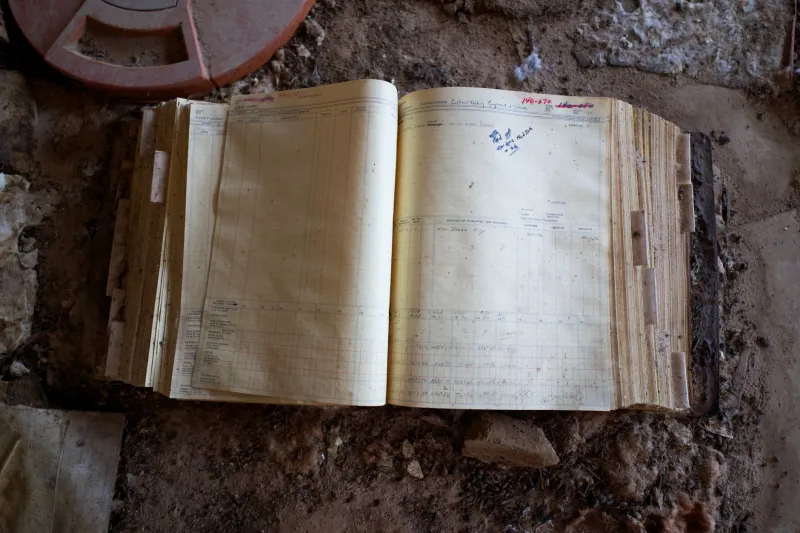
The practical consequence of those decisions is visible in the archive today. Researchers attempting to study IRS enforcement activity during the postwar decades frequently encounter records that simply stop. Not redacted. Not restricted. Gone.
What the Surviving Memos Say
Among the most revealing documents to emerge from FOIA requests filed by academic researchers and civil liberties organizations are internal guidance memos that discuss retention decisions with a candor unusual for bureaucratic correspondence. One category of documents that drew particular scrutiny involved enforcement files linked to civil rights organizations and labor groups during the 1950s through the 1970s—a period when the IRS, as later congressional investigations confirmed, had been used as an instrument of political surveillance.
The Church Committee hearings of 1975 brought significant attention to the IRS's role in programs like the Ideological Organizations Audit Project, which subjected nonprofits and civic groups to targeted examination based on their political affiliations rather than legitimate tax compliance concerns. What the hearings also revealed, though with less public attention, was that documentation of those programs had been selectively purged in the years prior to the investigation. Investigators found themselves reconstructing a surveillance apparatus from fragments—surviving copies, cross-referenced correspondence, and records that had been duplicated in other agencies' files.
The pattern suggested something more purposeful than routine housekeeping.
Demographic Enforcement and the Documentary Void
Beyond the question of political surveillance, archival researchers have begun examining whether IRS record destruction has obscured enforcement patterns along racial and socioeconomic lines. This line of inquiry is complicated by the very gaps it seeks to study, but surviving data points provide troubling context.
Academic work drawing on partial audit records and census-linked tax data from the mid-twentieth century has identified persistent disparities in audit rates affecting Black-owned businesses, immigrant communities, and low-income filers. The question historians now face is whether the documentary record that might have explained the institutional rationale for those disparities was among the material destroyed.
Several researchers who have spent years navigating IRS archival collections note that the surviving records tend to reflect the agency's formal policy positions rather than the operational decisions made at regional and district levels. It is precisely at that operational layer—where enforcement priorities were actually set and where demographic patterns would most clearly emerge—that the archival record is thinnest.
The destruction of district-level audit selection records, in particular, has been identified as a significant obstacle. Those files would have contained the criteria used to flag returns for examination, providing the clearest window into whether enforcement was being applied equitably. In many jurisdictions, those records no longer exist.
Reading the Gaps as Evidence
Archival historians have long argued that what is missing from a collection is itself a form of evidence. The principle applies with particular force to institutional archives, where decisions about what to keep and what to discard are made by the same organizations whose conduct the records might illuminate.
Applied to the IRS context, this interpretive framework yields unsettling conclusions. The concentration of destroyed records in categories most likely to reveal enforcement discretion—audit selection criteria, correspondence with regional administrators, files tied to politically sensitive investigations—is not a distribution one would expect from genuinely neutral housekeeping. It is the distribution one would expect if document management decisions were being shaped, at least in part, by an awareness of what the records contained.
This is not a claim that every destruction decision was made in bad faith. Federal agencies genuinely do face storage constraints, and retention schedules exist for legitimate administrative reasons. But the pattern of what survived and what did not demands a more searching explanation than bureaucratic convenience alone can provide.
The FOIA Frontier and Its Limits
For contemporary researchers, FOIA remains the primary instrument for recovering what institutional memory has not yet surrendered. Advocacy organizations, academic historians, and investigative journalists have filed thousands of requests targeting IRS records over the past several decades, and the results have been instructive—both for what they have produced and for the refusals and delays that have met many requests.
The IRS's FOIA response record has itself become a subject of scholarly interest. Researchers at several universities have documented systematic delays, broad invocations of exemptions, and, in some cases, agency claims that responsive records do not exist—claims that have occasionally been contradicted by records surfacing through other channels.
What FOIA cannot recover, of course, is what has already been destroyed. The archive of the future is being shaped right now by decisions about what to preserve, and the history of IRS record management suggests that those decisions cannot be left entirely to the discretion of the agency whose conduct the records reflect.
Toward a More Accountable Archive
The scholarly community has begun to articulate specific recommendations for closing the accountability gap that systematic record destruction has created. Among the most frequently cited proposals is the expansion of NARA oversight authority to require independent review of IRS retention schedules, particularly for categories of records touching on enforcement discretion and demographic patterns.
Digital preservation offers another avenue. As the IRS has modernized its recordkeeping infrastructure, advocates have pushed for policies requiring that electronic records be transferred to NARA custody on accelerated timelines, reducing the window during which agency administrators can influence what survives.
These are not merely technical archival debates. They are questions about whether the public can reconstruct a true account of how one of the federal government's most powerful agencies exercised its authority—and whether the communities most affected by that authority will ever have access to the documentary evidence their history deserves.
The receipts, as historians say, are in the record. When the record has been burned, the absence itself becomes the most important document of all.